
'We are confident that the US manufacturing industry will be able to take advantage of the US-India Investment Initiative to effectively support our goals of assisting in the development of three Indian cities -- Ajmer, Vishakhapatnam and Allahabad -- where the United States will be the lead partner,' Senators Warner and Cornyn told Obama.

PM Modi seems to be gradually ending India's strategic ambiguity

'In the past the US has been reluctant to name Pakistan directly in an US-India joint statement.'

China sees India and Japan's 'North East Road Network Connectivity Improvement Project' as a challenge to its OBOR, says Rajaram Panda.

'Modi's initial forays into foreign policy had the flavour of Aswamedha Yagas launched by ancient kings to conquer the world.' 'He overcame the hesitations of history and explored unconventional ways to win friends and influence people.' A fascinating excerpt from Ambassador T P Sreenivasan's new book, Modiplomacy -- Through a Shakespearean Prism.
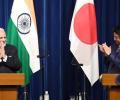
'Relations between India and Japan are robust and devoid of either shadow of history or any irritant.' 'In fact, there is plenty of warmth and goodwill earned over history. There are no negatives but only opportunities,' notes Dr Rajaram Panda.

"This will be the first dinner for a foreign dignitary at the White House under this administration. So, we think that's very significant," a senior administration official told reporters at the White House on the eve of Modi's arrival.
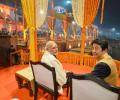
'Modi and Abe are working seriously for India-Japan bonhomie to grow stronger.' 'It is a win-win situation for both countries and the future look promising,' says Rajaram Panda, the Indian Council for Cultural Relations India Chair Visiting Professor at Reitaku University, Japan.
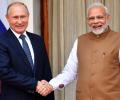
'Washington senses that the anchor sheet of India's strategic autonomy lies in its longstanding partnership with Russia, which remains firm and immutable despite the changes in world politics in the post-Cold War era,' notes Ambassador M K Bhadrakumar.<

Text of PM Narendra Modi's press statement after delegation level talks with US President Obama at the Hyderabad House in Delhi.

It was clear in Brunei at the 8th East Asia Summit that China doesn't want the South China Sea issue to even dominate the discussion, reports Sheela Bhatt, who is part of the prime minister's media contingent to the summit

'We have a common way of looking at the world, a common way of thinking, and a common set of values that predispose us to be partners. And our interests overlap greatly,' Dr Ashton B Carter, America's next defence secretary, told Aziz Haniffa/Rediff.com in an exclusive interview.

India is no longer shying away from playing a role on the regional and international stages and is willing to don a bigger role in regional politics. It is showing traits of a responsible stakeholder in the regional security dynamics, says Dr Rahul Mishra.

"The basic idea is that India would like to continue to be the most beautiful woman wooed by all men, notably the two strongest in the house, US and China," the article titled 'Indo-US strategic distrust stalls LSA signing'.

'While economic ties are making incremental progress, it is in the security and strategic domains that the India-Japan synergy is more compelling,' says Dr Rajaram Panda.
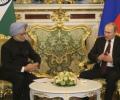
In a clear attempt to allay Russia's apprehensions, Prime Minister Manmohan Singh on Monday said it will remain an "indispensable" partner for India's defence needs even as he underlined that the bilateral ties should adapt to changing times to address challenges.

Australia's Prime Minister Tony Abbott on Friday said he will sign an agreement with India to sell uranium for non-weapon use. "Prime Minister Modi and I will today sign a nuclear cooperation agreement that will finally allow Australian uranium to India," he said while addressing a meeting, organised by industry chambers including CII and Ficci.

This is the joint statement issued by the ministry of external affairs on the visit of US President Barack Obama to India.
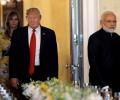
'China was the elephant in the Oval Office and Trump would have sensed that Modi's foreign policy architecture has become disoriented sans the US' pivot to Asia,' points out Ambassador M K Bhadrakumar.

Asked if the relationship has achieved its full potential, the President replied, "Absolutely not."

'By the time he came out after nearly five hours, he had a one-to-one conversation with the President, a delegation-level meeting, a reception, a dinner, a tour of the White House and a joint statement of a kind none of his predecessors ever had,' says Ambassador T P Sreenivasan.

'Modi's promise of change during the election campaign was on the domestic front, but his first year in office focused on foreign policy beyond all expectations,' says Ambassador T P Sreenivasan.

With PM Modi's visit, the time has come for a relook at India-Myanmar ties, and elevate the relationship to higher levels, says Dr Rahul Mishra.

Moving ahead with their new mantra -- Chalein Saath Saath: Forward Together We Go -- Prime Minister Narendra Modi and United States President Barack Obama on Tuesday vowed to deepen cooperation in every sector for the benefit of global stability and people's livelihoods over the next ten years.

With Donald Trump the appeal has to be to his business instincts in which his personal interests seem to play a significant role, says former foreign secretary Kanwal Sibal.
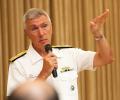
Admiral Samuel J Locklear III, Commander of the US Pacific Command, has not ruled out militants fighting in Afghanistan today switching their attention back to Kashmir post-US and NATO withdrawal of its troops from Afghanistan, and expressed concern over the recent terrorist attacks across the Line of Control that has exacerbated tensions between India and Pakistan.

With Beijing having had a profound rethink on India's admission as a full member of the Shanghai Cooperation Organisation, the tectonic plates of the geopolitics of a massive swathe of the planet stretching from the Asia-Pacific to West Asia are dramatically shifting. That grating noise in the Central Asian steppes will be heard far and wide -- as far as North America, says Ambassador M K Bhadrakumar.
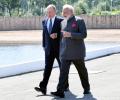
'The Vladivostok visit marks a subtle reversal of trend discernible in the revival of India-Russia relations pioneered by Modi during the past couple of years,' says Ambassador M K Bhadrakumar.

Prime Minister Narendra Modi on Tuesday said Australia will not be at the periphery of India's vision but at the centre of its thought, as he called for closer bilateral security cooperation and a comprehensive global strategy to tackle the menace of terrorism.

'The past year has yielded extraordinary results in the strategic, commercial, and people-to-people components of the India-United States partnership, US Ambassador to India Richard Rahul Verma tells Aziz Haniffa/Rediff.com in an exclusive interview.

'India alone cannot walk the path of peace. It also has to be Pakistan's journey to make,' says Prime Minister Narendra Modi at the government's geo-political flagship initiative "Raisina Dialogue-II".

'What gives hope is that Modi's own leadership is vitally linked to his capacity to deliver on the economic front. Indeed, if he succeeds, India's foreign policies will have changed beyond recognition,' feels Ambassador M K Bhadrakumar.

'Clearly, from the Indian viewpoint, the US retrenchment from Asia cannot be happening as good news.' 'The abandonment of the US' pivot to Asia exposes the US-Indian partnership to be a mere transactional relationship,' says Ambassador M K Bhadrakumar

One thing Beijing must understand is that India is not obsessed with being a threat to China but only wants a rightful place for itself in the world, says Sanjeev Nayyar.

Prime Minister Narendra Modi, who recently completed one year in office, has, in an exclusive interview with Smita Prakash, editor, ANI, said the opposition alleging that his government is a "suit boot ki sarkar" is definitely better and more acceptable than being labelled a "suitcase" (ki sarkar), and satirically added, that after ruling for sixty years, the Congress has suddenly remembered the poor.

'Modi's investment in the relationship with Washington is the biggest deliverable of this visit. He means business and that's fantastic!'

Prime Minister Narendra Modi on Thursday address Members of the British Parliament in London where he promised to open more doors of cooperation between the two countries and delved on issues like terrorism and United Nations reforms.

'The US wants Modi to succeed because we want India to succeed. For our part, when India thinks of its partners in the world, we want it to think of the US first. That means positioning our country as the preferred provider of the key inputs that can help to propel India's rise.' 'The meeting between Modi and Obama is, and must be, an opportunity for true strategic dialogue -- not a scripted exchange of talking points, but an open discussion of the big questions. What kind of world do we want to live in? What are our true priorities? And most importantly, why does this partnership still matter?'

'This is the first time that the Americans have agreed to refer to "cross-border terrorist attacks" in a joint statement.' 'No wonder Pakistan has called the joint statement "singularly unhelpful" and has blasted it, and its all-weather friend China has applauded Pakistan's frontline role in combating terrorism,' points out former foreign secretary Ambassador Kanwal Sibal.
A sensational interview on India-China ties, with the man most qualified to answer.
